


Choosing the right HVAC Insulation tape is essential for sealing, insulating, protecting and maintaining ventilation, heating and air-conditioning systems. The wrong tape can lead to air leakage, moisture issues, poor adhesion or premature failure. This guide explains how to compare aluminium tape, butyl tape and PVC tape, and how to select the right solution for your HVAC application.
What Is HVAC Insulation Tape?
HVAC Insulation tape is a technical adhesive tape used in heating, ventilation and air-conditioning systems to support insulation continuity, airtightness, thermal protection, moisture resistance or repair operations.
In HVAC environments, adhesive tapes are commonly used on:
- Air ducts
- Insulated panels
- Pipe insulation
- Ventilation units
- Air handling units
- HVAC maintenance areas
- Joints, seams and overlaps
Unlike general-purpose tapes, HVAC Insulation tape must be selected according to the operating conditions of the installation: temperature, humidity, surface type, fire requirements, exposure, mechanical stress and expected durability.
Why Tape Selection Matters in HVAC Applications
In HVAC systems, tape is not only used to “hold something in place”. It contributes to the performance and reliability of the installation.
A poorly selected tape can cause:
- Air leakage at duct seams
- Condensation around insulation joints
- Loss of thermal efficiency
- Peeling due to humidity or temperature variation
- Unplanned maintenance
- Poor visual finish on exposed installations
- Non-compliance with project specifications
A well-selected HVAC Insulation tape helps maintain the continuity of the insulation system and supports long-term installation quality. We highlight that HVAC adhesive tapes can improve airtightness, reduce heat loss, save installation time and support maintenance operations in constrained environments.
Main Types of HVAC Insulation Tape
Aluminium Tape for Thermal Insulation and Duct Sealing
Aluminium tape is one of the most common solutions for HVAC insulation, duct sealing and vapour barrier continuity. It usually consists of an aluminium foil backing combined with an adhesive system, often acrylic or rubber-based depending on the application.
Aluminium tape is particularly suitable when the application requires:
- Good thermal resistance
- Vapour barrier continuity
- Sealing of insulation joints
- Reflective surface finish
- Resistance to ageing
- Compatibility with metal ducts or foil-faced insulation
It is often used to seal joints between insulation boards, close seams on ducts, repair small tears in foil-faced insulation, or protect insulation overlaps from moisture ingress.
For duct sealing, metal-backed foil tape is often recommended as a durable alternative to cloth duct tape. ENERGY STAR specifically refers to metal tape for sealing accessible duct leaks and connections.
When to Choose Aluminium Tape
Choose aluminium tape when the priority is thermal insulation continuity, airtightness or moisture barrier protection. It is generally the right option for metal ducts, foil-faced insulation materials and exposed HVAC components where a clean metallic finish is expected.
Typical use cases include:
- Sealing joints on rigid ducts
- Joining foil-faced insulation boards
- Closing overlaps on pipe insulation
- Repairing damaged vapour barriers
- Protecting insulation seams from humidity
- Supporting thermal insulation performance
Check our aluminium range here.
Butyl Tape for Waterproofing and Air Sealing
Butyl tape is a flexible sealing tape based on butyl rubber. It is valued for its tack, conformability and sealing performance on irregular surfaces. In HVAC applications, it is often used where waterproofing, air sealing or vibration-tolerant bonding is required.
Butyl tape is useful when surfaces are not perfectly flat or when the application requires a flexible seal rather than a thin foil closure.
Key Strengths of Butyl Tape
Butyl tape is often selected for:
- Waterproof sealing
- Air leakage reduction
- Gap filling
- Irregular surfaces
- Outdoor or semi-exposed areas
- Overlaps between different materials
- Joints exposed to movement or vibration
It can be used around HVAC housings, pipe penetrations, panel joints, access doors, external ventilation components or sealing areas where a thicker adhesive mass is beneficial.
When to Choose Butyl Tape
Choose butyl tape when you need a durable seal rather than only a surface closure. It is especially relevant for applications exposed to moisture, condensation risk or small surface irregularities.
However, butyl tape is not always the best choice for clean visible finishes or very thin insulation seams. It is thicker than aluminium tape and can be more difficult to apply neatly on narrow joints. For this reason, it should be selected when sealing performance is more important than visual discretion.
Have a look at our butyl range here.
PVC Tape for Protection, Wrapping and Identification
PVC tape is a flexible plastic tape used for wrapping, protection, colour coding and, in some cases, electrical insulation. In HVAC environments, PVC tape can support maintenance operations, pipe identification, harness wrapping and protection of specific components.
PVC tape is not usually the first choice for high-temperature duct sealing or vapour barrier continuity. Its strength lies in flexibility, ease of application and adaptability to curved or complex shapes.
Common Uses of PVC Tape in HVAC
PVC tape can be used for:
- Wrapping cables or harnesses
- Protecting small components
- Colour coding HVAC networks
- Marking fluid circuits
- Temporary bundling
- Electrical insulation in appropriate conditions
- Maintenance identification
For HVAC contractors and OEMs, PVC tape can be useful when the application requires a flexible tape that follows shapes easily and offers a clean finish.
When to Choose PVC Tape
Choose PVC tape when the need is mainly protection, wrapping, identification or electrical insulation, rather than duct sealing. It can be useful in HVAC equipment manufacturing, maintenance operations and installation environments where installers need a practical and flexible tape.
Before selecting PVC tape, always check temperature resistance, flame-retardant properties, adhesive compatibility and project requirements.
Learn more about our PVC tapes here.
How to Choose the Right HVAC Insulation Tape
The right HVAC Insulation tape depends on the application, surface, environment and performance expected. A tape that works well on a foil-faced insulation board may not be suitable for a humid outdoor joint or a curved PVC pipe.
1. Define the Main Function
Start by identifying the main role of the tape:
- Sealing air leaks
- Maintaining insulation continuity
- Protecting against moisture
- Joining insulation panels
- Wrapping cables or pipes
- Marking HVAC circuits
- Repairing damaged insulation
- Reducing vibration or noise
If the goal is sealing a duct or insulation seam, aluminium tape is often preferred. If the goal is waterproof sealing on an irregular surface, butyl tape may be more relevant. If the goal is wrapping or identification, PVC tape may be sufficient.
2. Check the Surface Material
Adhesion depends heavily on the surface. HVAC tapes may be applied on:
- Galvanised steel
- Aluminium foil
- Flexible duct material
- Insulation facing
- Plastic pipes
- Painted metal
- Rubber
- Foam
- Composite panels
Before selecting HVAC Insulation tape, check whether the adhesive is compatible with the substrate. Some adhesives perform well on metal but poorly on low-surface-energy plastics. Others need pressure, clean surfaces or specific temperature conditions during application.
3. Consider Temperature Resistance
HVAC systems can be exposed to heat, cold and temperature cycles. The tape must remain stable in the expected operating range.
Key questions:
- Is the tape exposed to hot air?
- Is it used near heating components?
- Will the installation face freezing conditions?
- Are there repeated expansion and contraction cycles?
- Is the tape applied indoors or outdoors?
Aluminium tape is often selected for applications requiring better thermal stability. PVC tape may have lower temperature resistance depending on the grade. Butyl tape can perform well in sealing applications but must be checked against the operating temperature range.
4. Assess Humidity and Condensation Risk
HVAC installations often face condensation, especially around chilled water pipes, air-conditioning systems and poorly insulated areas. In those cases, tape selection must account for moisture exposure.
For condensation-prone areas:
- Use tapes with strong moisture resistance
- Avoid tapes that absorb water
- Ensure full contact with the surface
- Seal overlaps carefully
- Avoid wrinkles or gaps
- Check vapour barrier continuity
Aluminium tape is often used to preserve vapour barrier continuity on foil-faced insulation. Butyl tape can help where waterproof sealing is required around penetrations or joints.
5. Verify Fire and Compliance Requirements
Some HVAC projects require tapes to meet specific fire, smoke or duct closure standards. This is particularly important in commercial buildings, public buildings, industrial facilities and regulated environments.
For air duct applications, verify whether the specification requires UL 181 listed tapes or equivalent local standards. Some aluminium foil tapes are listed for rigid duct board or flexible duct closure applications, while some film tapes are designed for flexible duct systems. 3M, for example, lists HVAC foil and polypropylene duct tapes with UL 181 references for duct closure applications.
6. Match the Format to the Application
Performance is not only about adhesive chemistry. Tape format also matters.
Consider:
- Roll width
- Roll length
- Liner or linerless format
- Thickness
- Manual or automated application
- Small rolls for installers
- Long rolls for production lines
- Die-cut parts for repeated assembly
- Custom slit widths
For industrial HVAC manufacturers, custom converting can improve repeatability and reduce waste. EUROBANDS and ADDEV Materials offers converting capabilities such as custom cutting, slitting, adapted formats and long coils for HVAC production lines.
Applications and Concrete Examples in HVAC
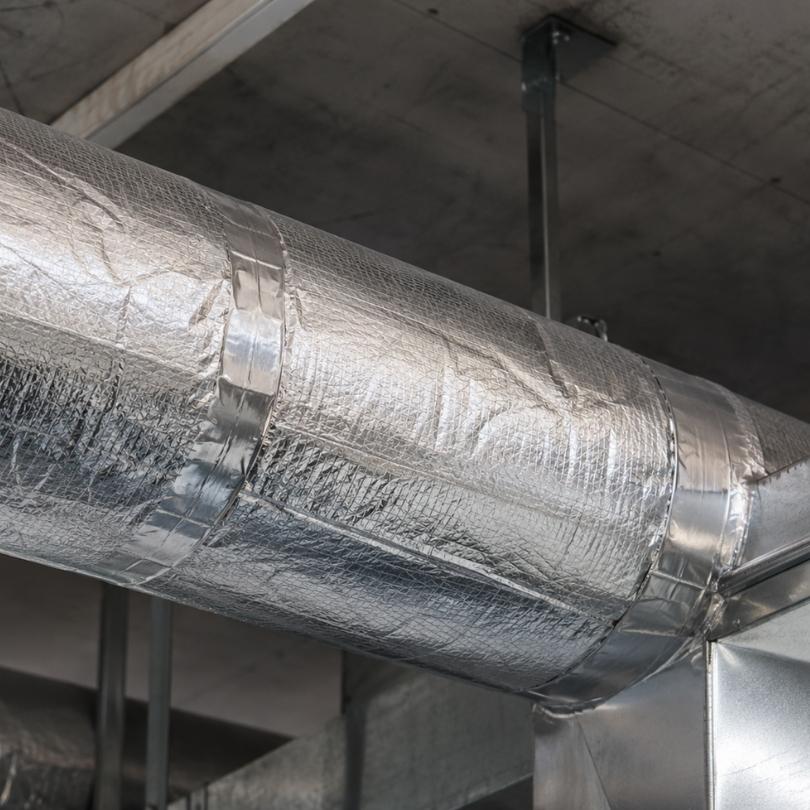
Insulation Joints on Air Ducts
For foil-faced insulation around air ducts, aluminium tape helps seal joints and maintain the continuity of the vapour barrier. This reduces the risk of condensation and supports the thermal performance of the insulation system.
Recommended tape: aluminium tape.
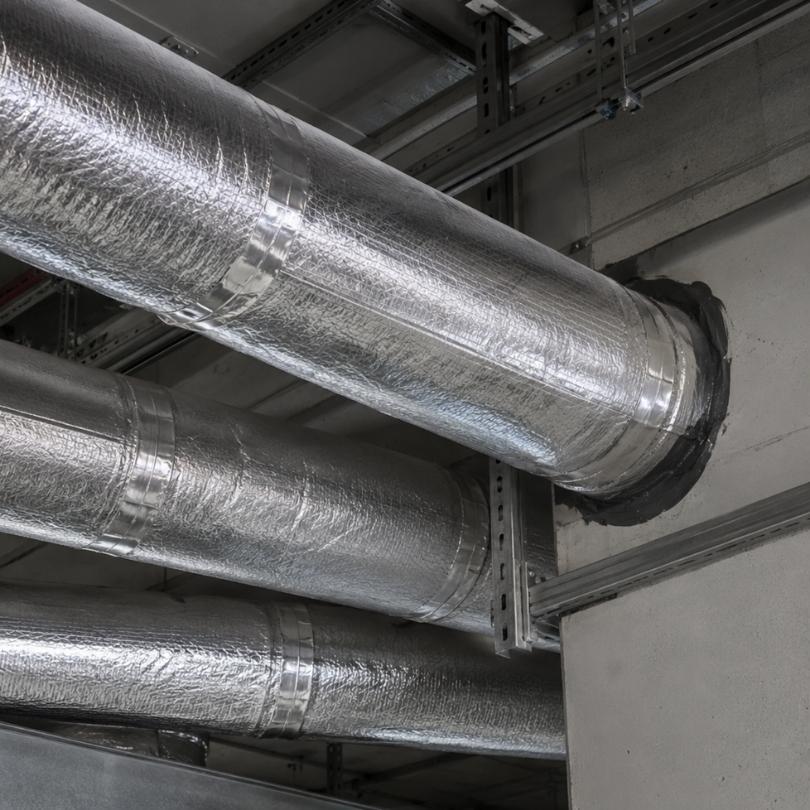
Pipe Insulation Around Heating and Cooling Networks
Pipe insulation often requires clean closure of longitudinal seams and joints. Aluminium tape can be used on foil-faced insulation, while butyl tape may be relevant around penetrations or irregular sealing points.
Recommended tape: aluminium tape for seams, butyl tape for sealing details.

Air Handling Units and HVAC Equipment
In HVAC equipment manufacturing, tapes can be used to fix foams, seals, films or protective materials. Depending on the function, aluminium tape, PVC tape or double-sided technical tapes may be selected.
Recommended tape: aluminium tape for thermal areas, PVC tape for wrapping or identification, technical adhesive tapes for assembly.

Maintenance and Repair Operations
During maintenance, technicians may need to repair damaged insulation, close small gaps, mark pipes or protect components. The tape must be easy to apply, reliable and adapted to the surface.
Recommended tape: aluminium tape for insulation repair, butyl tape for sealing, PVC tape for marking or wrapping.

HVAC Piping Systems and Fluid Networks
Fluid networks require reliable sealing, mechanical protection and identification. ADDEV Materials identifies watertight joints, pipe protection and circuit marking as typical needs in HVAC piping systems.
Recommended tape: butyl tape for watertight sealing, PVC tape for identification, aluminium tape for insulation-facing continuity.
Benefits of Using the Right HVAC Insulation Tape
A properly selected HVAC Insulation tape can deliver several technical and operational benefits:
- Better airtightness: helps reduce air leakage at duct joints and seams.
- Improved insulation continuity: limits thermal bridges and protects insulation overlaps.
- Moisture protection: supports vapour barrier integrity and reduces condensation risks.
- Faster installation: simplifies sealing and repair compared with some mechanical methods.
- Cleaner finish: provides a neat surface on exposed insulation or ductwork.
- Reduced maintenance: limits premature peeling, leaks and rework.
- Better productivity: custom widths and roll lengths help installers and production teams work faster.
- Application flexibility: adapted solutions are available for ducts, pipes, panels, equipment and maintenance areas.
- Support for compliance: selected tapes can help meet project or duct closure requirements when certified grades are used.
Best Practices for Applying HVAC Insulation Tape
Choosing the right tape is only the first step. Correct application is essential for performance.
Prepare the Surface
Before applying HVAC Insulation tape, make sure the surface is:
- Clean
- Dry
- Free from dust
- Free from grease or oil
- Stable
- Compatible with the adhesive
Poor surface preparation is one of the main causes of tape failure.
Apply Enough Pressure
Pressure-sensitive tapes need pressure to create proper adhesive contact. Apply firm pressure along the full length of the tape, especially on edges, overlaps and corners.
For aluminium tape, use a squeegee or roller when possible to avoid air bubbles and wrinkles.
Avoid Tension During Application
Do not stretch the tape excessively during application. Tension can cause lifting, shrinkage or edge peeling over time, especially on curved surfaces.
Respect Overlap Recommendations
When sealing insulation joints or vapour barriers, overlap the tape enough to ensure continuous coverage. Avoid gaps between tape strips.
Choose the Right Width
A tape that is too narrow may not cover the joint properly. A tape that is too wide can be harder to apply cleanly around corners or curved surfaces.
For industrial users, custom slitting can provide the right width for each application. See ADDEV Materials’ converting expertise here: Roll cutting and slitting.
Store Tapes Correctly
Tape performance can be affected by storage conditions. Keep rolls away from excessive heat, humidity, dust and direct sunlight. Always respect shelf-life and storage recommendations from the manufacturer.
Aluminium Tape vs Butyl Tape vs PVC Tape: Quick Comparison
| Tape type | Best for | Main strengths | Limits |
|---|---|---|---|
| Aluminium tape | Duct sealing, insulation joints, vapour barrier continuity | Thermal resistance, moisture barrier, clean finish | Less suitable for large gaps or very irregular surfaces |
| Butyl tape | Waterproof sealing, air sealing, irregular joints | Strong sealing, conformability, moisture resistance | Thicker, less discreet, may not suit clean visible finishes |
| PVC tape | Wrapping, marking, protection, identification | Flexible, easy to apply, useful for maintenance | Not the first choice for thermal duct sealing or vapour barriers |
Common Mistakes to Avoid
Using Standard Duct Tape for Long-Term HVAC Sealing
Despite its name, standard cloth duct tape is not usually the right solution for durable HVAC duct sealing. For long-term performance, use appropriate metal tape, mastic or certified duct closure products depending on the application.
Choosing Tape Only by Price
The cheapest tape can become expensive if it fails after installation. Rework, leakage, maintenance and customer dissatisfaction often cost more than choosing the right tape from the beginning.
Ignoring Surface Compatibility
A tape can be technically strong but fail if the adhesive is not compatible with the surface. Always test adhesion on the real substrate before large-scale use.
Applying Tape on Wet or Dirty Surfaces
Moisture, dust and grease reduce adhesive contact. Surface preparation is essential, especially in maintenance environments.
Forgetting the Application Temperature
Some adhesives need a minimum application temperature to bond correctly. A tape applied in cold conditions may not reach its expected adhesion level.